
#TBCDiagnosis: She asked for help finding a side hustle. What she needed was to raise her rates.
These are from Career Clarity Move sessions, where the goal is to answer a career question you have in 1 hour. Usually it's "why am I not getting offers". Sometimes it's a complete wildcard like today. All names and details are anonymized here. So if you have recommendations for names for the next ones, just send them over. I'm using list of UK baby names that I never hear in my real life.

#TBCDiagnosis: She asked for help finding a side hustle. What she needed was to raise her rates.
Mabel is a physical therapist, a couple of years into practice. She works as a consultant across a few clinics, gets paid by the hour for every client she sees, and she genuinely loves the work. She has no plans to stop.
But she was missing something.
Back in college, she ran events, and she loved it. The planning, the coordinating, the creativity. The rush. Now she wanted that feeling back.
So she booked a Career Clarity Move with a very specific question: how does she get a part-time events job? Something flexible enough to fit into the 2 free days she has each week (not the weekend). In an industry she’s passionate about. Where she can grow and learn. And get paid quite well for.
I told her straight away: that combination is highly unlikely.
Flexible, part-time, in a passion industry, with room to grow, and pays well? Pick 2 max.
Passion industries are full of people who’d do the work for very little, and the ones hiring want someone dedicated. The truly flexible jobs are the ones where you could be swapped out for anyone, any day, any time.
So she shifted. Maybe she could be a VA instead? A lot of her friends were doing it.
And that’s where I stopped her.
“Is it that you want to pursue your passion, or that you want to make money? Because in the past 10 minutes, you haven’t once talked about money.”
She’d come in talking about passion, creativity, and fulfillment. Wanting to find a feeling from work. And scheduling someone’s calendar as a VA didn’t feel aligned with any of that. So which was it?
That question opened everything up.
Mabel supports her family. Like a lot of Filipinos her age, a big part of what she earns goes straight home to taking care of everyone. There’s a specialization course she’s been wanting to take for her career, and it’s expensive. So she’s been putting it off for years. The family needed that money more.
But every time she spends money on herself, on things that aren’t going to the family she has to defend it:
“I need to live my life too.”
Then she said something that made it all click:
“I need to be successful as fast as I can….so I can enjoy my life guilt-free.”
Everything fell into place instantly. I pointed out to Mabel that she was looking for a side hustle that would fulfill 2 different goals. She wanted it to provide excitement and happiness that she couldn’t find in both her physical therapist job and her rest days.
The events job wasn’t really about events. It was about wanting something that felt like hers, while carrying a lot of weight for other people. The VA idea wasn’t really about being a VA. It was about the pressure to earn more, fast.
Neither one was going to fix what was actually wrong.
Because this wasn’t a job hunt. She already has a job. She already has a skill people pay good money for.
The career question Mabel had to answer was never “what second job can I squeeze in?” It was “what does my career need to look like so I can support my family better and still have a life?”
So that’s what we worked on instead.
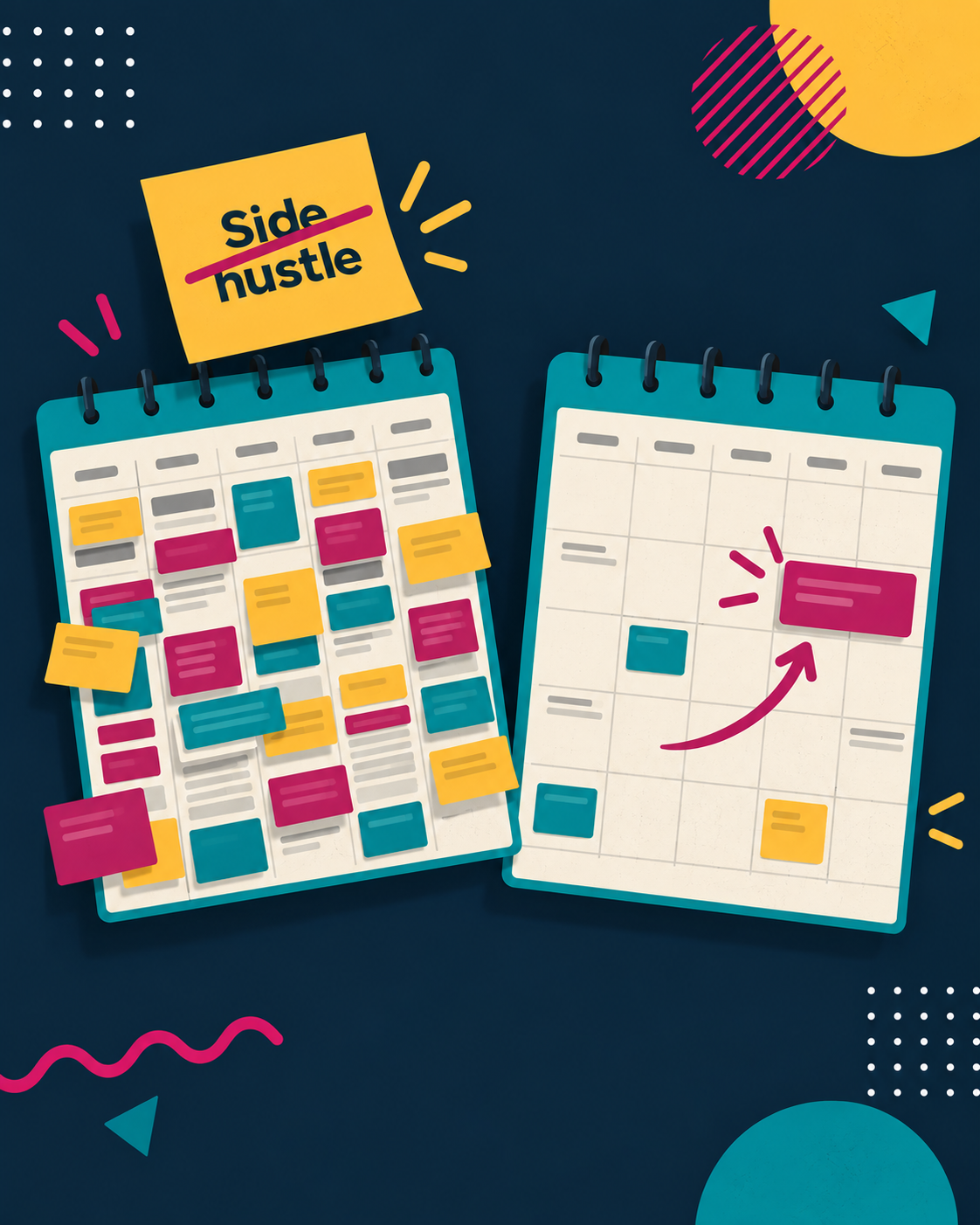
Now we focused on the operational next steps. I asked her a few more questions, this time about the job she already has.
And the answer was sitting right there. She gets paid per client hour, at rates the clinics set. She’d never once priced herself. She’d never looked at which day of her week paid her the least. And she’d never compared any of it to what any other employer would pay her for the exact same skill.
She didn’t need a side hustle. She needed to raise her rates.
So we did the math together, live on the call. What her lowest-paid day earns her now. What she’d need per day to reach a number that actually feels stable. And how far apart those 2 numbers really were. (Not as far as she thought once we did all the math.)
By the end of the hour, she had a plan she could start on the very next week: a target day rate, the one day of her week to test it on, and who to offer it to first. No extra hours. No extra days. No second job.
And that expensive certification she’d been stressing about? We counted exactly how many days at her new target day rate would cover it.
So take this as a sign: raise your rates.
Here’s what I keep seeing: a lot of the people I talk to are supporting their families. That’s normal for so many of us. I do it too. But it means the career question is almost never just a career question.
The side hustle, the passion project, the sudden urge to switch fields. Sometimes it’s a real calling. But often it’s pressure looking for a way out, or exhaustion looking for something to feel excited about. And if you answer the question on the surface, you can spend a year chasing a job that was never going to fix what’s underneath.
And almost every time, there’s a fuzzy number sitting in the middle of it.
Mabel kept saying she just wanted to be “stable.” I started counting how many times she said it and gave up at 14. I kept asking, “Stable at how much?” She didn’t know.
“Don’t ever accept a fuzzy number. Always know how much you need to survive, and how much you need to thrive.”
You can’t figure that out from inside the pressure. You need someone who can hear the question you’re asking, and notice the one you’re actually trying to answer.
That’s the job. Not handing you a list of side hustles. Telling you where the plan you’re chasing doesn’t match what you actually need, so you stop spending your energy on the wrong problem.
If you've read this far, here's the rest of what we got through in that one hour. Consider it a thank-you for your attention and a sneak peek of what we could talk about as well.
Flexible, part-time, and in a passion industry: the honest truth about that combination, and what it would actually take to find it.
“Should I be a VA?”: why the new career everyone recommends wasn’t built for her schedule and what are the caveats of joining in.
Passion or money: how to tell which one you’re really chasing or whether you’re confusing yourself by prioritizing both at the same time.
Surviving vs. thriving: putting a real number on both and an exercise on how to get clear on what that actually looks like specifically for you.
Earning more without working more hours: a different way to look at the skill she already has. (AKA raise your rates.)
Finding her niche: which clients would pay more for the expertise she already has.
The certification question: whether it’s worth it, how to calculate the ROI of it, and how to plan time into achieving it.
Guilt and money: working through the mental gymnastics of spending on yourself when you’re supporting your family. (This is not easy and can’t be solved in 1 session but it’s a start.)
Working backwards: the planning exercise I give my students to map out the next 10 years. The goal is not to hit every goal listed but to build the systems to go above and beyond.
The portfolio career: keeping her passion alive without burning out on her main career.
This is who I coach. People with real skills and real pressure, who’ve been working hard on the wrong question.
And it's why I offer these calls. You're not paying for an hour of listening. You’re paying for an expert eye that has heard dozens of people ask one question while needing the answer to another, and can tell the difference fast.
If that sounds a little too familiar, Career Clarity Move is a 60-minute session built for exactly this: your plans and your questions on the table, with someone who isn’t too close to your story to see what’s actually there.
***
The Bumpy Career's Career Clarity Move is for the high achiever who’s stuck on a career decision, and isn’t sure they’re even asking the right question.
It’s to diagnose, audit, and prescribe what to change to hit that ideal goal. Meaning: whether it’s a side job, a pivot, or a whole new field, the fix is the same. You need someone who can hear your plan and clock in a few minutes what’s really driving it. And then can diagnose the gap between the question you came in with and the one you actually need answered.
That’s where I come in.
In 60 minutes, I tell you exactly where the mismatch is: in your plan, your numbers, your timeline, and what you actually want. So you leave knowing what to do next and why, instead of another year chasing the wrong answer.
If that sounds like where you are right now, you can book your own Career Clarity Move here and let's figure out what's actually been getting in your way.